Swimming for Community
By Amos Chan
Pacific Masters Diversity & Inclusion Committee Member
When I turned 30 last summer, I was fortunate to have a few friends celebrate the turning of the decade with me. While I met them at different stages of my life, I realized that the common denominator for most of us was meeting through swimming.
There was Foofoo (childhood nickname that I still use to this day), who I grew up with in age group swimming in Canada. We met on the swim team, cheered for each other during races and relays, consoled each other after subpar swims, eventually went to the same high school, and even went to prom together. Despite living on opposite coasts, we still keep in touch regularly. Age group swimming was my introduction to a team environment, and was where some of my favorite memories of teenage years were formed with my teammates; spending the entire weekend at a pool, winter training camp in Montreal was not so bad after all with the laughs and shenanigans along the way.
There was Nicole and Adam, two of my good friends from my first masters team, the Atlanta Rainbow Trout. Moving to a new city in my early 20s without knowing anyone was a little nerve-wracking, but I was thankful I found Trout, as swim practice was where I made my first few friends. Getting to swim in a former Olympic facility was also a nice bonus. Joining an LGBTQ+ team without having much of a queer community up to that point was pivotal and contributed to my self acceptance process and identity development. There was something about swimming alongside people who had been through similar journeys and struggles that allowed me to feel more open. It was relieving to be able to show up to practice as my authentic self. I did not swim competitively in college, so swimming on a masters team reminded me how much I enjoyed seeing friends at practice and going to swim meets with them. In a nutshell, the Trout era was about going beyond my comfort zone. Nicole and Adam certainly contributed to this, from open water/triathlons and beyond, and I’m ever grateful for my Trout friendships.
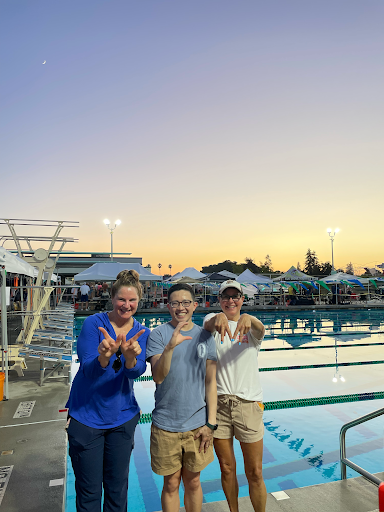
There was Sherri and Nathan, from my current team, Walnut Creek Masters. When work brought me out west, I once again relied on masters swimming as a starting point to build a new community. I joined the PacMasters D&I committee, and Vicki Shu connected me with Ian King, who graciously carpooled me to morning practices when I didn’t yet have a car. Being part of a larger team has given me the opportunity to meet many swimmers with different swimming backgrounds and histories, and I’ve enjoyed getting to know the morning and evening crews. Spending time with teammates like Sherri and Nathan in and out of the pool has helped make the Bay Area feel more like home. I can already tell this team will have a lasting impact on me with its special blend of team camaraderie and supportive coaches.
When life brings me to new places, I always appreciate the familiarity of the pool. At times, swimming can feel like a very individual sport, and the team is where we develop a sense of community and belonging. Just like our swim times, the feeling of belonging can waver, and the events that transpired in the latter half of last year were a wake-up call, showing how progress does not always happen on a one-way trajectory.
The policy changes from last year, as well as the ongoing lawsuits, target vulnerable members of the swimming community and lead us down a path towards a very unwelcoming atmosphere, particularly towards trans swimmers. It sends a hostile message, antithetical to USMS values, that not all masters swimmers are valued equally and can dissuade even prospective swimmers from taking part in the sport or joining a team.
While our lanemates may change out and our strokes may all look a little different, I believe most of us share a simple “raison d’etre” as masters swimmers – to connect with others while getting in a good workout. Recognizing our commonalities over our differences is a starting point for fostering mutual respect; a core principle for a healthy, inclusive team environment. As someone who’s been on the receiving end of acts of kindness from teammates-turned-friends, I’m reminded that seemingly small gestures can accumulate and contribute towards feeling welcome and included. With compassion and empathy, our swimming community can grow to be welcoming to all.