My USMS Diversity & Inclusion Story
by Kate Andrup Stephensen
“Hold Up” on the sprints and pass me a snorkel. . .
A story of re-finding joy and camaraderie in non-elitist masters swimming.
ALTS (Adult Learn-to-Swim) is about coaching for proficiency not correcting deficiency, it is about catering to the masses rather than fostering elitism. Bridge to Masters is about providing a space for folks transitioning from learn to swim to full swimmers the opportunity to continue to learn the sport while they transition onto a team. When I see a team that promotes ALTS and Bridge to Masters programming it is a cue that they value inclusive coaching and diverse teams.
Masters Swimming suffers from an “elitism” problem in that the word itself seems to insinuate that only those who are of a certain background can join. As a recent NYTimes article on re-learning to swim better in middle age states, “swimming culture is intimidating, with its caps and goggles and rules about lane splitting.” That you must have the right gear, have a stereotypical swimmer body, be motivated to compete, and/or have attained a certain status in the sport in order to participate are all common reasons that people opt not to join USMS or, in the case of myself, opt out.
ALTS and Bridge to Masters are breaking that restrictive mold. The result is a culture of swimming that is encouraging of all swimmer types. From those who are not yet able to swim to crazy people such as myself who find greatest joy in chasing the black line for hours on end, all are welcome on a USMS team.
I consider myself an ALTS swimmer although I have been swimming since I was a child and racing for over 25 years. Why? I am an enthusiastic learner who finds herself happiest in the water. Although I feel more confident in the water than on land, I am always curious to learn more about the sport I love.
Throughout my competitive swimming career, I sustained several overuse injuries, multiple traumatic brain injuries, and multi-level spinal damage resulting in three surgeries all before the age of 35. Protecting my body from vulnerability has become a very real challenge. As a result of those experiences I suffer from early onset arthritis, persistent angst about when the next injury is going to knock me out, and chronic pain.
But, although I still perseverate at times over whether continuing to swim is a good idea for me, I know that an active life is healthier than a sedentary life and, like many USMS swimmers who find themselves unable to work out in other ways, swimming is the best exercise given my physical limitations.
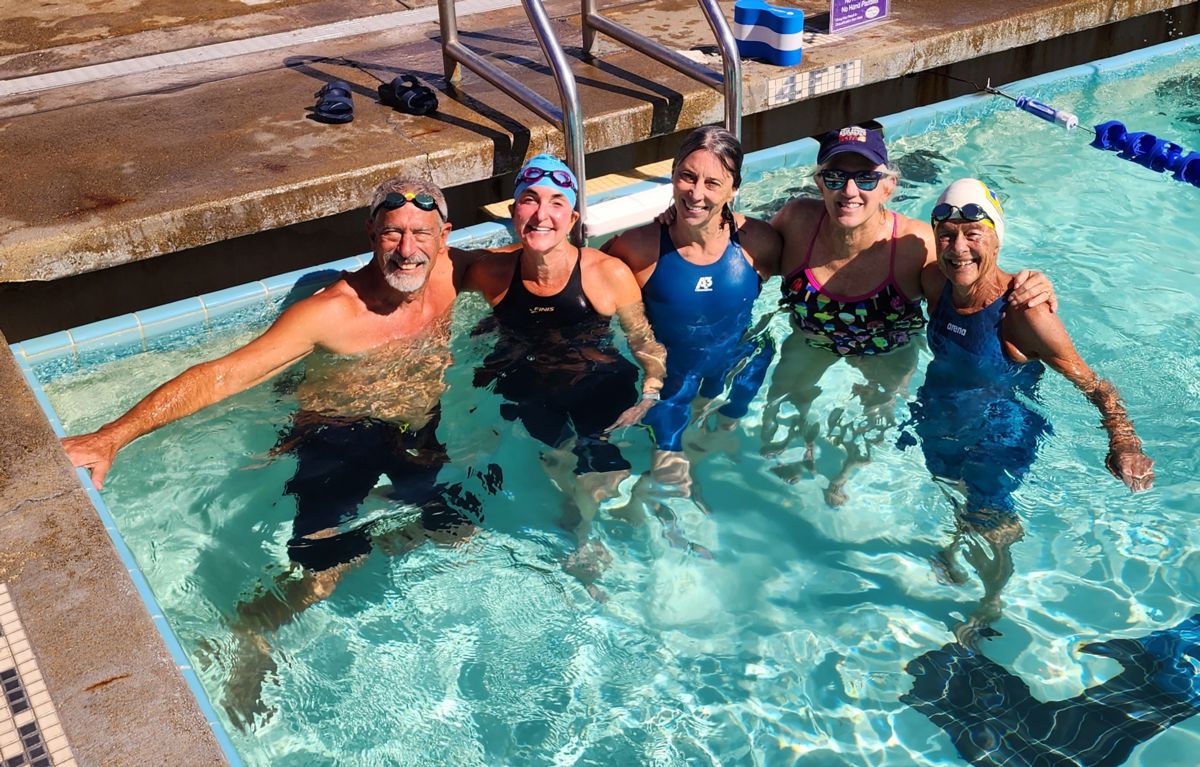
Being at the pool stills reminds me of the coaches who insisted that I push through pain to the point of injury. While the angst and fear linger, the quiet sensory deprivation of the water creates a sense of calm for my over-active mind and the literal buoyancy provides a space of healing for my injured spine. I find calm, safety, and joy in the waters of Davis Aquatic Masters (DAM) as led by Head Coach Matt Zachan and Assistant Head Coach Sean Kos. Both coaches know the sport in and out, work the deck well, differentiate to each swimmer’s needs, unify the team in workouts even in our differences, and create an energy of joy at the pool. They develop a universally welcoming environment that is focused on “feeling over form”, individualization of stroke techniques over uniformity, and differentiation of coaching tips over universalized commentary. While coaches use to expect that I “do as they say” regardless of the pain it caused, they provide stroke tips that help me swim with less pain and thus a more genuine smile.
Furthermore, I see them coaching all swimmers regardless of speed, experience, or ability with the same genuine enthusiasm and focus. Those positive vibes generated by the DAM coaching staff emphasize inclusion over competition and diversity over uniformity. That helps me to feel safer in the water. Why? Because it means I can spend time chatting with my lane mates, wear as many assistive devices as I need without worry of ridicule or opt to swim slowly in a workout without worry of the coaches pushing me to perform. It also means I feel comfortable asking questions, getting out early if I need to, and swimming for me rather than swimming for someone else’s ego.
My favorite thing to do in the water is swim with fins and a snorkel because it minimizes the pain caused by rotating my head and reduces wear on my damaged shoulder joints. For the aging former competitive swimmer, being able to accommodate with swimming accessory’s such as a snorkel and fins is a helpful way to moderate overuse or poor form injuries that commonly occur because of a life in sport. Matt helped me develop that strategy. I use to swim through pain to the point of injury, now I aspire to swim smarter thanks to his clever innovations. Sean helps reinforce technique by filming my stoke and providing lane-side commentary. This is super helpful because I often have no sense of what my body is doing, but seeing film and hearing his critique helps reinforce the helpful stroke guidance that he provides.
All swimmers, regardless of background need an individualized approach to feedback that addresses their potential physical limitations and fosters their goals. The work that Matt and Sean do is promoting of diversity because they create a climate that includes all swimmers regardless of ability in the water or prior experience with the sport of swimming.